Not everybody learns, communicates, processes information or experiences their environment in the same way.
That sounds obvious.
And yet many of the systems we use in education and therapy are still designed around the idea that there is one “normal” way of doing all of those things.
Read this information.
Complete this form.
Listen to these instructions.
Lie here quietly.
Tell me if you’re uncomfortable.
For a neurodivergent person, some of those seemingly simple things may not be quite so simple.
What do we mean by neurodiversity?
Neurodiversity describes the natural variation in how human brains function and process information.
The term is often discussed in relation to conditions such as autism, ADHD, dyslexia, dyspraxia and other neurological differences.
And, importantly, two people with the same diagnosis may have completely different experiences.
One person with ADHD might struggle to concentrate during a long explanation but learn incredibly quickly when something is demonstrated practically.
Another may need written instructions to refer back to.
An autistic client may find certain sounds, smells or types of touch overwhelming, while another autistic person may have no difficulty with them whatsoever.
So perhaps the most useful starting point is this:
Don’t assume. Ask.
Neurodiversity in the training room
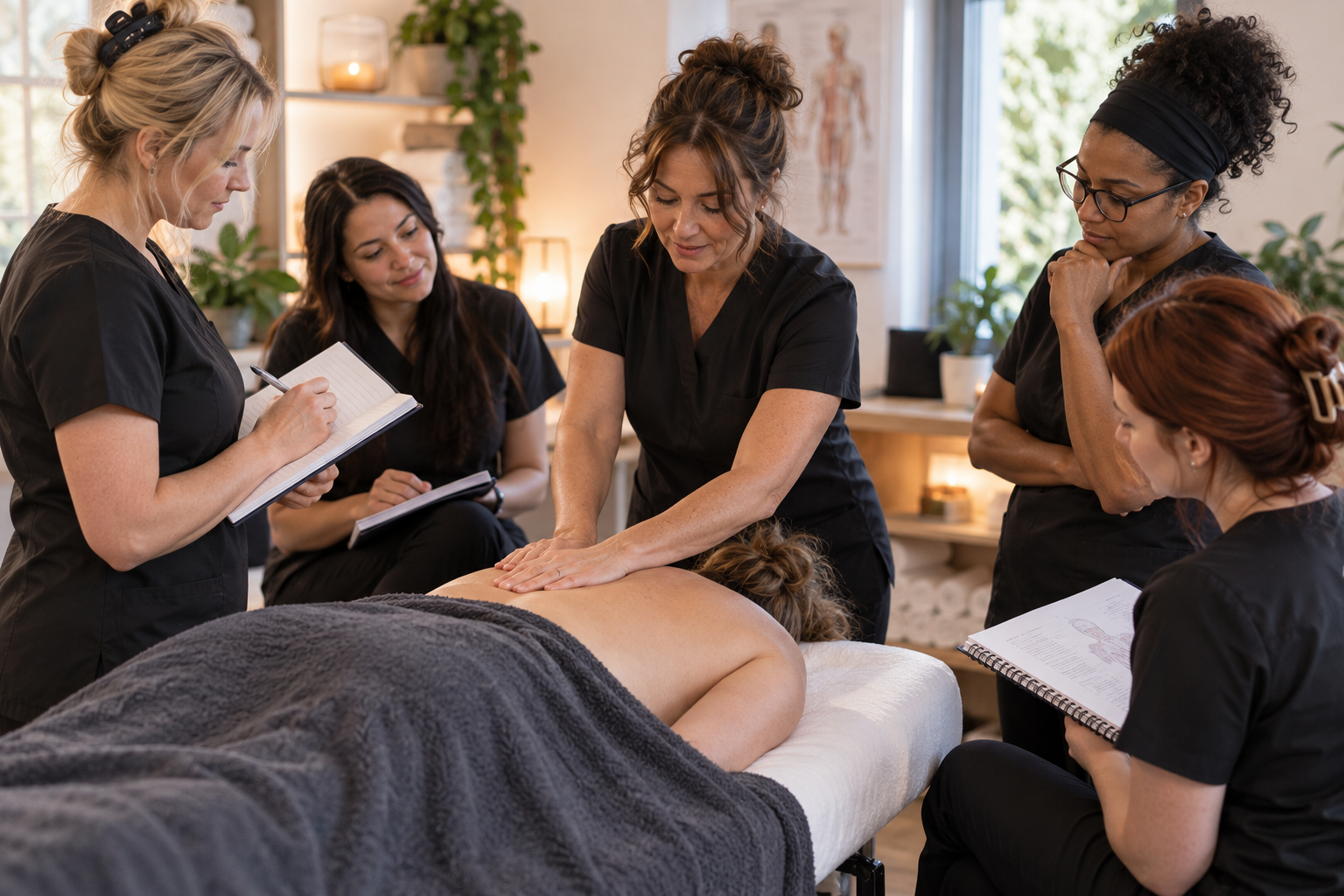
Practical therapy training already lends itself quite well to different ways of learning.
We can explain something.
Demonstrate it.
Let students practise it.
Provide written material.
Repeat it.
Discuss it.
That gives learners several different ways of processing the same information.
But tutors can sometimes mistake difficulty processing information for a lack of ability.
A student might understand a technique perfectly once they physically perform it but struggle to follow several verbal instructions at once.
Someone with dyslexia may produce written work containing spelling or grammatical errors while having an excellent understanding of the subject.
A student with ADHD might appear distracted during a long discussion but become completely engaged during practical work.
None of these things automatically tells us whether that person will become a good therapist.
Reasonable adjustment doesn’t mean lowering the standard
This distinction is really important.
Supporting a learner doesn’t mean removing the competencies they need to demonstrate.
A therapist still needs to practise safely.
They still need to understand contraindications.
They still need to communicate appropriately with clients and demonstrate the knowledge and practical skills required for their qualification.
What may change is how they are supported in getting there.
That could mean allowing additional processing time, breaking instructions into smaller stages, providing information in different formats, allowing appropriate movement breaks or checking understanding privately rather than repeatedly asking, “Does everyone understand?”
Because quite often everyone nods.
That doesn’t necessarily mean everyone understood.
Then they become the therapist
Neurodiversity doesn’t disappear when someone finishes training.
A neurodivergent therapist may develop their own systems for managing appointments, consultations, treatment notes and the working day.
Some may prefer very structured routines.
Some may need more time between clients.
Others may find particular aspects of running a business more challenging while being exceptionally good at the actual therapeutic work.
There isn’t one correct way to organise yourself as a therapist.
If the system is professional, safe and works for you and your clients, that’s what matters.
And, of course, our clients are neurodiverse too
This is where awareness can make a surprisingly big difference.
Think about a typical treatment environment.
Low lighting.
Background music.
Essential oils or scented products.
Physical touch.
Conversation.
Being asked to remove clothing.
A therapist moving around the room.
For many people, that’s relaxing.
For somebody with sensory sensitivities, elements of it could be uncomfortable or overwhelming.
And the answer isn’t to create an entirely different treatment before every neurodivergent client arrives.
It’s simply to communicate.
“Are you comfortable with the lighting?”
“Would you prefer music or no music?”
“Is the pressure okay?”
“Would you like me to explain what I’m going to do before I begin?”
Small questions can give a client much more control over their experience.
Communication can look different too
We sometimes expect clients to tell us immediately when something isn’t right.
But not everybody finds that easy.
Some people need longer to process a question before answering.
Some may take language very literally.
Others may find open-ended questions difficult and respond better when given more specific choices.
Someone may also appear comfortable because they aren’t verbally objecting, while internally they are becoming increasingly overwhelmed.
This is another reason that good consultation isn’t simply about completing a form.
It’s about getting to know the person sitting in front of you.
Don’t turn the diagnosis into the person
There’s another trap worth avoiding.
Once somebody tells us they’re neurodivergent, it can become very easy to view everything through that label.
But your client isn’t “the autistic client”.
Your student isn’t “the ADHD student”.
They’re an individual who happens to have told you something that may help you support them better.
Ask what they need rather than assuming you already know.
Sometimes they’ll need an adjustment.
Sometimes they won’t.
Sometimes they’ll know exactly what helps them.
And sometimes they’ll still be figuring that out themselves.
Good inclusive practice often helps everybody
Interestingly, many adjustments associated with neurodiverse learning are simply good teaching.
Clear instructions.
Demonstrations.
Written information.
Breaking complex tasks into manageable stages.
Opportunities to practise.
Regular checks for understanding.
The same is true in the therapy room.
Clear communication, informed consent, checking comfort, explaining what will happen and giving clients choices shouldn’t be reserved for neurodivergent people.
They’re simply good practice.
Perhaps that’s the biggest takeaway.
We don’t need to become experts in every neurological difference before we can become more inclusive therapists or tutors.
We need curiosity, flexibility and a willingness to listen.
Because different brains may have different needs.
And good therapy — and good teaching — has always been about treating the person in front of us.