

Picture a successful therapist and what do you see?
A beautiful treatment room. Perfect lighting. Fluffy towels stacked neatly on shelves. Expensive products lined up in matching bottles.
Possibly a suspicious number of plants.
It looks lovely.
But do you actually need any of that to start working as a therapist?
Not necessarily.
In fact, taking on a treatment room too early can turn an exciting new business into an expensive monthly bill before you’ve even built a client base.
Start with the clients, not the room
It’s very tempting to think:
“Once I’ve got my room sorted, I can start my business.”
But the room isn’t the business.
The clients are.
Before committing to rent, deposits, furniture and equipment, think about where your first clients are realistically going to come from.
How many appointments do you expect to have each week?
How much will you charge?
What will the room cost you?
And crucially:
How many treatments do you need to provide before you’ve even paid for the room?
If your room costs £50 for the day and your treatments are £50 each, your first client hasn’t really earned you £50.
They’ve paid for the room.
Your second client is where the day starts looking rather more interesting.
Working from home
For some therapists, home-based practice works brilliantly.
Your overheads may be considerably lower and you don’t have to travel between appointments.
It can also give you much more flexibility.
But there are practical considerations.
Do you have a suitable private space?
Can clients access it easily?
Is there parking?
What about other people in the house?
Pets?
Noise?
Toilet facilities?
Can the room genuinely feel professional rather than like you’ve squeezed a massage couch between the sofa and the television?
You’ll also need to consider things such as insurance, mortgage or tenancy conditions and any local requirements that apply to your circumstances.
Home-based doesn’t mean unprofessional.
It simply needs to be thought through.
Renting a room
Room rental can be a great middle ground.
You get a professional environment without taking on your own premises.
And there are lots of different arrangements.
Some therapists rent by the hour.
Some pay per day.
Some work on a percentage split.
Others rent a room for particular days each week.
Before agreeing to anything, work out what you’re actually getting for your money.
Is equipment included?
Laundry?
Reception?
Booking support?
Marketing?
Storage?
Can you leave your products there?
And what happens if you have no clients booked that day?
A beautiful £100-a-day room isn’t quite as beautiful when your diary contains one £45 treatment.
Mobile therapy
Then there’s the option people sometimes overlook completely.
You go to the client.
Mobile therapy can be an excellent way to start because you’re not paying for a room while your business is still growing.
It can also appeal to clients who struggle to travel, have busy lives or simply prefer being treated at home.
But again, there are practical realities.
You need to transport your equipment.
You need enough time between appointments to travel, set up and pack away.
Parking can be unpredictable.
And carrying a treatment couch up three flights of stairs will very quickly teach you the importance of asking about access before accepting a booking.
Your pricing needs to reflect that.
A one-hour mobile treatment rarely takes only one hour of your working day.
You can mix and match
Your business model doesn’t have to fit neatly into one box.
You might work from home two days a week and rent a room somewhere else for one.
You could offer mobile appointments to selected clients.
You might rent a treatment room one day a week initially and increase your days as demand grows.
You can change your model as the business develops.
The setup you start with doesn’t have to be the setup you use forever.
Don’t choose based on what looks successful
Social media can give us a slightly distorted idea of what a therapy business should look like.
A gorgeous clinic photographs beautifully.
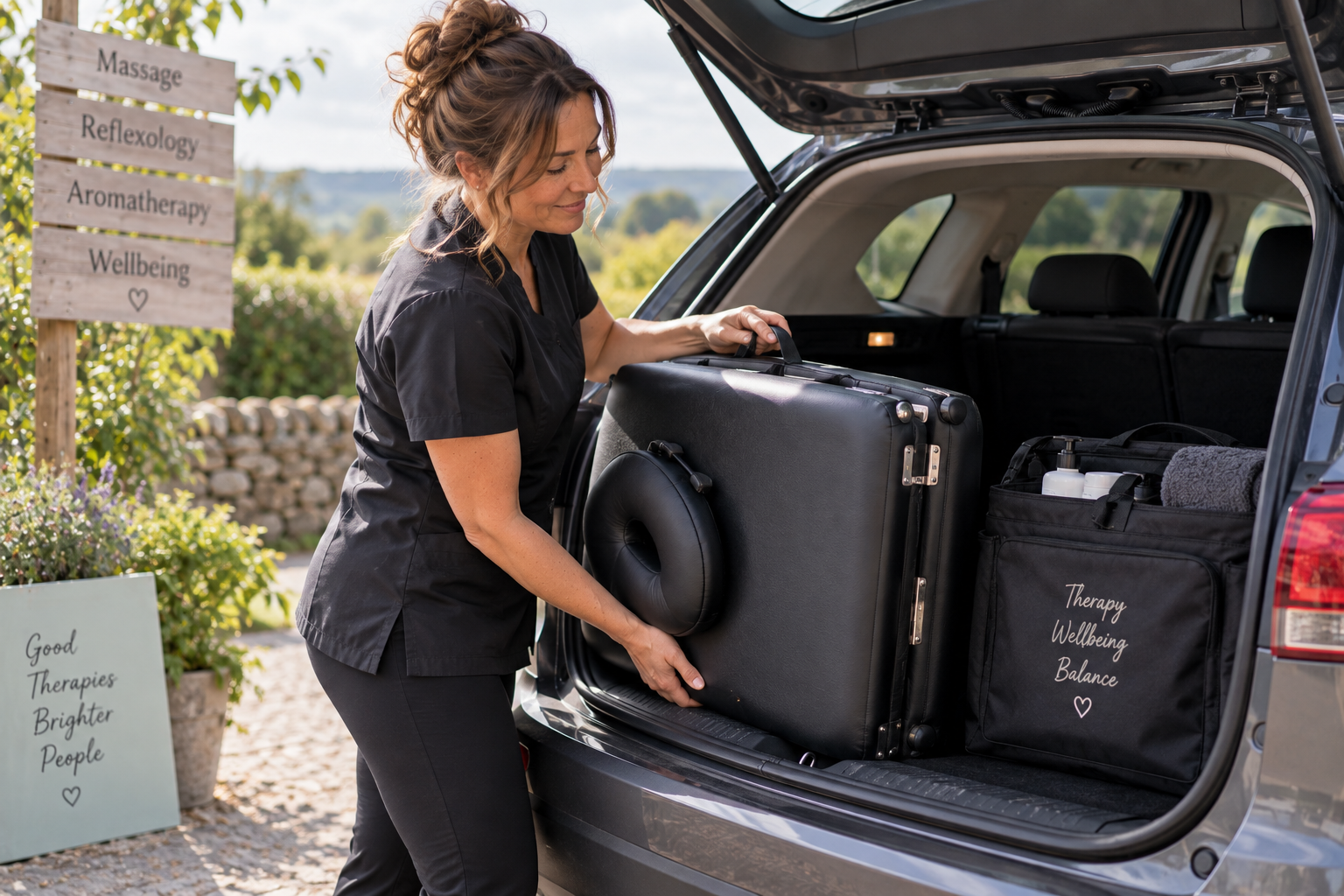
A therapist loading a massage couch into the back of a hatchback doesn’t have quite the same Instagram appeal.
But appearances don’t tell you whether the business is profitable.
Someone working from a modest home treatment room with low overheads and a loyal client base may have a far healthier business than someone paying thousands every month for an impressive clinic.
The question isn’t:
“Which option makes me look most successful?”
It’s:
“Which option works for my business right now?”
Make the numbers boringly realistic
Before committing to premises, do some very simple maths.
If the room costs £300 per month, how many treatments pay for it?
Now add insurance.
Products.
Laundry.
Card fees.
Booking software.
Utilities if applicable.
Marketing.
Professional memberships.
Training and CPD.
And don’t forget that you need to pay yourself.
Revenue isn’t income.
Seeing £1,000 worth of treatments in your diary doesn’t mean you’ve earned £1,000.
Understanding that early can save a lot of stress later.
Your clients care more about how you make them feel
Of course the environment matters.
It should be clean, comfortable, safe, private and appropriate for the treatment you’re providing.
But it doesn’t need to look like a five-star spa.
Clients remember whether you listened to them.
Whether they felt comfortable.
Whether the treatment was good.
Whether you remembered what they told you last time.
Whether they felt looked after.
Beautiful décor is lovely.
Good therapy is better.
Build the business you actually need
There is no single correct way to start a therapy business.
For one person, a dedicated treatment room makes perfect sense from day one.
For somebody else, renting one day a week is the sensible choice.
Another therapist might build an excellent business working entirely from home.
Someone else may love mobile work.
Start with what is realistic.
Keep your overheads sensible.
Build your client base.
And allow the business to earn the right to grow.
Because you don’t need the perfect treatment room to become a successful therapist.
You need somewhere appropriate to work — and people who want to come back.


