“I’m a visual learner.”
“I need to actually do it.”
“I remember things better if somebody explains them to me.”
“I need to write everything down.”
Spend any time in a training room and you’ll hear variations of all four.
And it makes sense.
We all have ways of learning that feel easier or more natural to us.
But does that mean every student has one particular learning style and should only be taught in that way?
Not quite.
What happened to learning styles?
For years, education commonly talked about people being visual, auditory or kinaesthetic learners.
The idea was simple.
Visual learners learn best by seeing.
Auditory learners learn best by hearing.
Kinaesthetic learners learn best by doing.
You may even have completed a questionnaire at some point that told you which one you were.
The problem is that research hasn’t provided good evidence that matching teaching to someone’s supposed learning style improves learning.
That doesn’t mean people don’t have preferences.
Of course they do.
It means we probably shouldn’t put somebody into a box and decide:
“She’s a visual learner, so that’s how she needs to be taught.”
Humans are rather more complicated than that.
The subject determines how we need to learn
Imagine trying to learn massage entirely by reading about it.
You could understand the theory.
You might know what effleurage is.
You could describe body mechanics beautifully.
But eventually you’re going to need to put your hands on somebody.
Now imagine learning anatomy entirely through practical demonstration without ever seeing a diagram, reading terminology or discussing how structures relate to one another.
Again, something would be missing.
Different information lends itself to different methods.
So rather than asking:
“What type of learner is this person?”
we can ask:
“What’s the best way to teach this particular thing?”
See it. Hear it. Do it. Think about it.
Good practical training naturally uses more than one route to learning.
A student might first read about a massage technique in their manual.
The tutor then explains it.
Next they watch a demonstration.
Then they practise it themselves.
The tutor provides feedback.
They practise again.
Later, they may need to explain why they chose that technique within a client scenario.
Suddenly one piece of learning has been approached in several different ways.
And every stage adds something different.
Demonstration matters
In hands-on therapy, watching an experienced practitioner can provide information that’s difficult to capture in words.
Where are they standing?
How are they transferring their weight?
What does their hand position look like?
How quickly are they moving?
How does one technique flow into another?
Students can read:
“Maintain good posture.”
But seeing good posture in action makes the instruction much more meaningful.
This is why demonstrations and video resources can be so valuable alongside written manuals.
But watching isn’t enough
We’ve probably all watched somebody do something and thought:
“Yes. Easy. I can do that.”
Then tried it.
Absolutely not easy.
Practical learning needs practical experience.
The student’s brain is now coordinating movement, pressure, position, sequence, client comfort and approximately seventeen other things at once.
At first, that can feel incredibly awkward.
Then repetition begins to turn separate instructions into a skill.
You can’t shortcut that part.
Eventually the student needs to do.
Some people need the words too
A student can perform something successfully without necessarily understanding why they’re doing it.
That’s why theory still matters.
What structures are underneath your hands?
Why might this treatment need adapting for a particular client?
What does that medical condition mean?
Why is this a contraindication?
What are you trying to achieve?
Practical competence without underpinning knowledge isn’t enough for professional practice.
Neither is excellent theoretical knowledge without the ability to apply it.
We need both.
Discussion makes students use knowledge differently
This is where scenarios can become particularly useful.
Rather than simply asking:
“What are the contraindications to massage?”
give the student a client.
Forty-eight years old.
Desk-based job.
Persistent shoulder tension.
Controlled hypertension.
Recently started medication.
Poor sleep.
Wants deep pressure because “that’s the only thing that works”.
Now what?
Suddenly the student has to retrieve knowledge, decide what’s relevant, ask questions and apply what they’ve learned.
That’s very different from memorising a list.
And much closer to what they’ll actually need to do once qualified.
Writing can help organise thinking
Not everybody enjoys written work.
But writing can serve a purpose beyond assessment.
Treatment plans.
Case studies.
Reflections.
Client records.
These require students to organise information and explain their reasoning.
For some learners, writing helps cement knowledge.
For others, it is considerably harder.
That’s where good course design matters.
Written work shouldn’t exist simply because courses are supposed to have paperwork.
It should have a reason.
What are we asking the student to demonstrate?
Repetition isn’t boring when you’re building a skill
Students sometimes worry that they’re “still practising the same thing”.
Good.
Professional skill doesn’t usually appear after doing something once.
The first attempt might be:
“Where do my hands go?”
The fifth:
“Okay, I remember the sequence.”
The tenth:
“I can concentrate on my pressure now.”
Later:
“I’ve noticed this client needs something slightly different.”
That’s progression.
Repetition frees up mental capacity.
Once the basic skill becomes more familiar, the student can start thinking more deeply about the person they’re treating.
Variety helps without labelling anybody
One student may particularly appreciate diagrams.
Another loves practical demonstrations.
Someone else remembers the discussion you had around a client scenario.
Another goes home and watches the demonstration video three times.
That’s fine.
We don’t necessarily need to decide which “type” of learner each person is.
Provide good-quality learning in different formats and let students use the resources that help them.
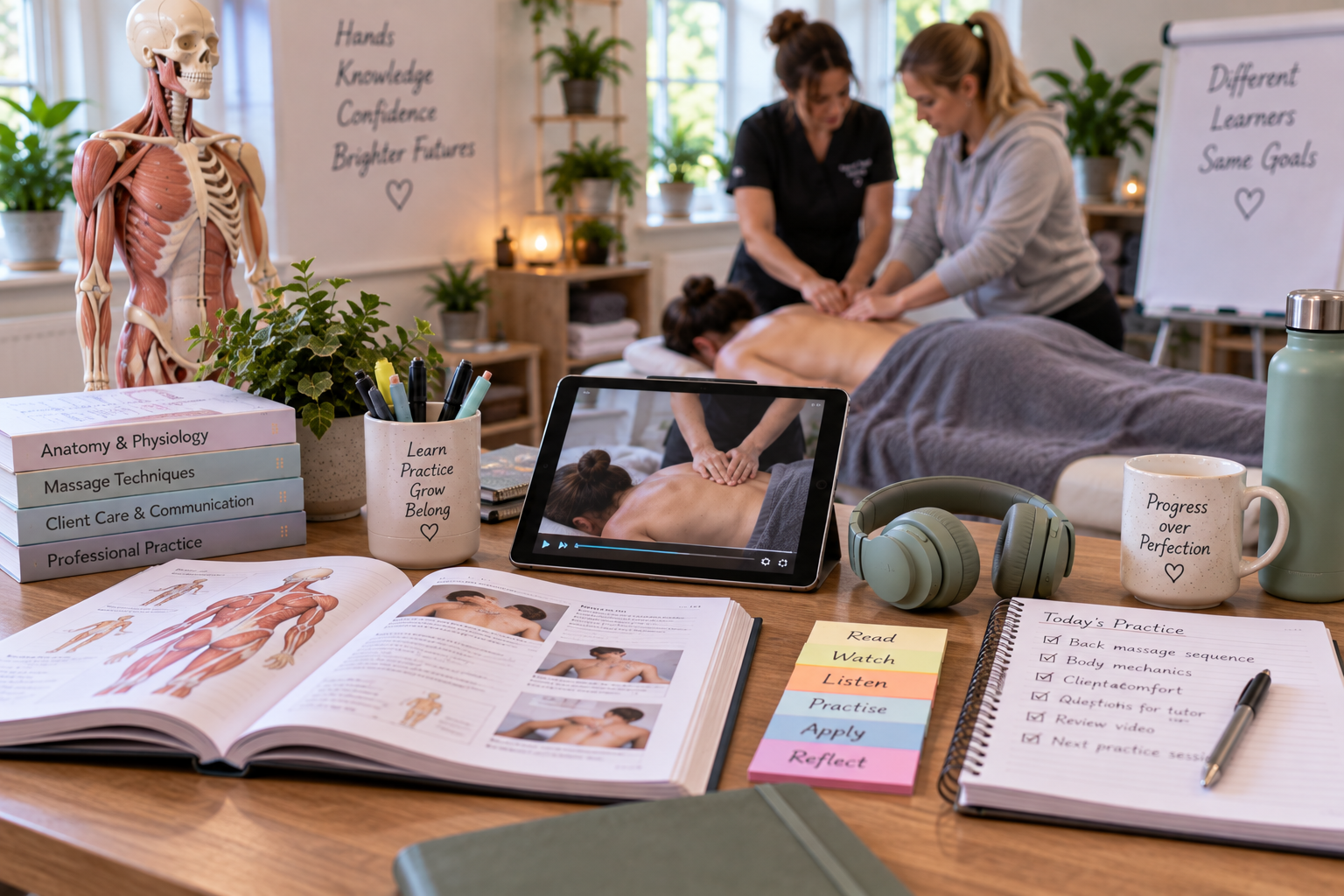
A strong course might include:
Written learning.
Images and diagrams.
Tutor explanation.
Demonstration.
Video.
Guided practical work.
Independent practice.
Discussion.
Client scenarios.
Questioning.
Reflection.
None of these replaces all the others.
Together, they create depth.
Neurodivergent learners may particularly benefit from choice
Providing information in different ways can also remove barriers.
A dyslexic student may find a diagram or demonstration helps make dense written information clearer.
Someone with ADHD may engage much more easily once theory is connected to a practical task.
An autistic learner may particularly value clear written instructions they can revisit rather than relying solely on verbal information.
But again, we shouldn’t assume.
Ask the learner what helps.
And importantly, many adjustments that help neurodivergent students improve learning for everybody.
Clear instructions are good teaching.
Demonstrations are good teaching.
Breaking complex tasks into stages is good teaching.
Providing opportunities to practise is good teaching.
The goal isn’t to make learning easy
Training should challenge students.
They’re preparing to work independently with real people.
They need knowledge.
They need practical competence.
They need judgement.
They need to solve problems.
Inclusive teaching doesn’t mean removing that challenge.
It means removing unnecessary barriers that prevent somebody from demonstrating what they can actually learn and do.
The professional standard stays where it is.
We simply provide more than one route towards reaching it.
So what kind of learner are you?
Maybe you’re visual.
Maybe you learn by doing.
Maybe you need to write things down.
Or perhaps — like most of us — it depends entirely on what you’re trying to learn.
So rather than worrying about fitting everybody into a learning-style box, let’s give students something much more useful.
Let them read it.
See it.
Hear it.
Discuss it.
Practise it.
Apply it.
Reflect on it.
And then practise it again.
Because there may not be one perfect way to learn.
But there are plenty of good ways to teach.