
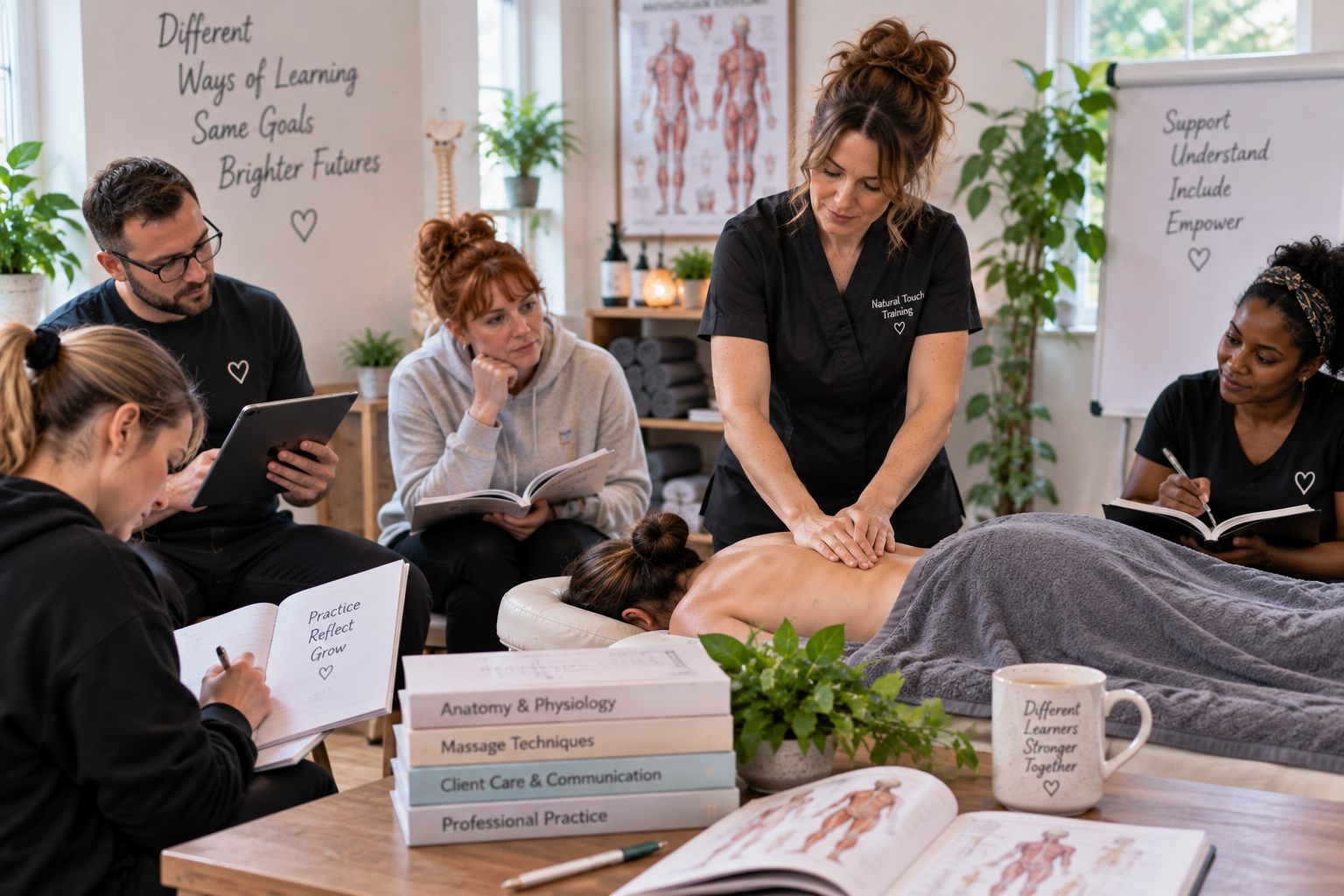
One student takes pages of beautifully organised notes.
Another barely writes anything down but remembers every practical demonstration.
Someone needs to read an instruction three times before it makes sense.
Another understands immediately — then completely forgets what you said ten minutes later.
One student asks question after question.
Another understands perfectly well but struggles to explain their answer on paper.
Welcome to a training room full of human beings.
People learn differently.
And when a student is neurodivergent, those differences may be particularly noticeable.
The challenge for a good tutor isn’t to make everybody learn in the same way.
It’s to help different learners reach the same required standard.
A diagnosis doesn’t tell you how somebody learns
ADHD.
Autism.
Dyslexia.
Dyspraxia.
You may have taught students with one or more of these diagnoses.
You may also have taught neurodivergent students who haven’t told you, don’t have a formal diagnosis or don’t yet realise it themselves.
But knowing somebody has ADHD doesn’t automatically tell you what support they need.
Two people with the same diagnosis can learn very differently.
One student may need written instructions.
Another may find a page full of text overwhelming.
One may need silence to concentrate.
Another may focus better while moving or doing something with their hands.
So rather than thinking:
“How do I teach someone with ADHD?”
a much more useful question is:
“What helps this particular student learn?”
Practical ability and written ability aren’t the same thing
This is especially important in therapy education.
A student may perform a treatment beautifully.
They communicate well with the client.
Their positioning is safe.
They adapt appropriately.
They understand what they’re doing.
Then you read their written work and wonder whether you’re looking at the same student’s work.
Spelling may be poor.
Sentences may be disorganised.
Information they explained perfectly in conversation suddenly seems confused on paper.
That doesn’t mean written knowledge doesn’t matter.
It does.
But tutors need to distinguish between the competency being assessed and difficulties with the method through which the student is demonstrating it.
If we’re assessing whether somebody understands a contraindication, the important question is whether they understand it — not whether every word is perfectly spelt.
Sometimes the student looks as though they aren’t listening
A student is doodling.
Looking around the room.
Fidgeting.
Not making eye contact.
You assume they’ve switched off.
Then you ask them a question and they give you the answer.
Attention doesn’t always look the way we expect it to look.
For some neurodivergent people, moving, doodling or looking away may actually help them process information.
That doesn’t mean tutors should ignore disruptive behaviour or abandon classroom expectations.
It means being cautious about assuming what is happening internally based purely on what attentive behaviour is “supposed” to look like.
Long instructions can disappear halfway through
Imagine being told:
“Wash your hands, adjust the couch, position the bolster, check the client’s comfort, start on the left side and remember we’re changing the first technique today.”
Some students will retain all of that.
Others heard:
“Wash your hands… something… bolster… left… WHAT ARE WE DOING?”
Working memory and processing differences can make multi-stage verbal instructions particularly difficult.
Breaking instructions into smaller steps can help.
So can demonstrating while explaining.
Or putting key stages somewhere students can see them.
Interestingly, this usually helps everybody in the room — not just the neurodivergent student.
Processing time isn’t the same as not knowing
Tutors naturally ask questions.
“What are the contraindications?”
“Which muscle are we working over?”
“What would you change for this client?”
And when a student doesn’t answer immediately, it’s tempting to jump in and help.
But some people need a little longer to process the question, organise the answer and say it.
Silence can feel surprisingly long when you’re teaching.
Give it a few seconds.
You may discover the student knew the answer perfectly well.
Their brain just needed a little more time to retrieve it.
Clear doesn’t always mean simple
Sometimes tutors worry that adapting how they explain something means “dumbing it down”.
It doesn’t.
Clear teaching can still contain complex information.
You can explain a concept verbally.
Show it visually.
Demonstrate it practically.
Give an example.
Let the student try it.
Then connect it back to the theory.
The standard hasn’t changed.
You’ve simply provided more than one route to understanding it.
And in practical therapy education, that’s often exactly what we should be doing anyway.
Reasonable adjustments don’t mean an easier qualification
This is probably one of the most important points.
An adjustment should help remove an unnecessary barrier.
It shouldn’t remove the competence the student is required to demonstrate.
If safe practice is required, the student must practise safely.
If they need to identify contraindications, they need to demonstrate that knowledge.
If they need to perform a treatment independently, eventually they need to demonstrate that they can.
The destination remains the same.
The route may look slightly different.
Ask the student
Tutors sometimes feel they’re expected to instantly know exactly what adjustment a student needs.
You aren’t.
The student may already know what works for them.
Try:
“What usually helps you when you’re learning something new?”
“Would it help if I demonstrated that again?”
“Would you prefer the instructions written down?”
“Do you need a couple of minutes to process that?”
Those conversations are far more useful than making assumptions based on a label.
And sometimes the student won’t know.
That’s okay too.
You can work it out together.
But students have responsibilities as well
Inclusive teaching is a partnership.
Tutors can provide appropriate support and reasonable adjustments.
Students still need to engage with their training.
They need to complete required work.
They need to practise.
They need to communicate if they’re struggling.
And, where possible, they need to let the training provider know if they require adjustments.
Neurodiversity can explain why somebody finds aspects of training more difficult.
It doesn’t mean professional requirements disappear.
Support and accountability can exist at the same time.
Different doesn’t mean less capable
A student who struggles with written work may become an exceptional practical therapist.
Someone who needs longer to learn a routine may eventually understand it in extraordinary depth.
A student who asks endless questions may be developing exactly the kind of curiosity that will make them a thoughtful practitioner.
And yes, neurodivergent students can have areas where they genuinely need additional support.
The aim isn’t to romanticise neurodiversity or pretend challenges don’t exist.
It’s simply not to confuse different with incapable.
Good teaching has never really been about delivering information and hoping everybody absorbs it in exactly the same way.
It’s about helping people learn.
And sometimes that means changing how we teach — without changing what we’re teaching them to become.