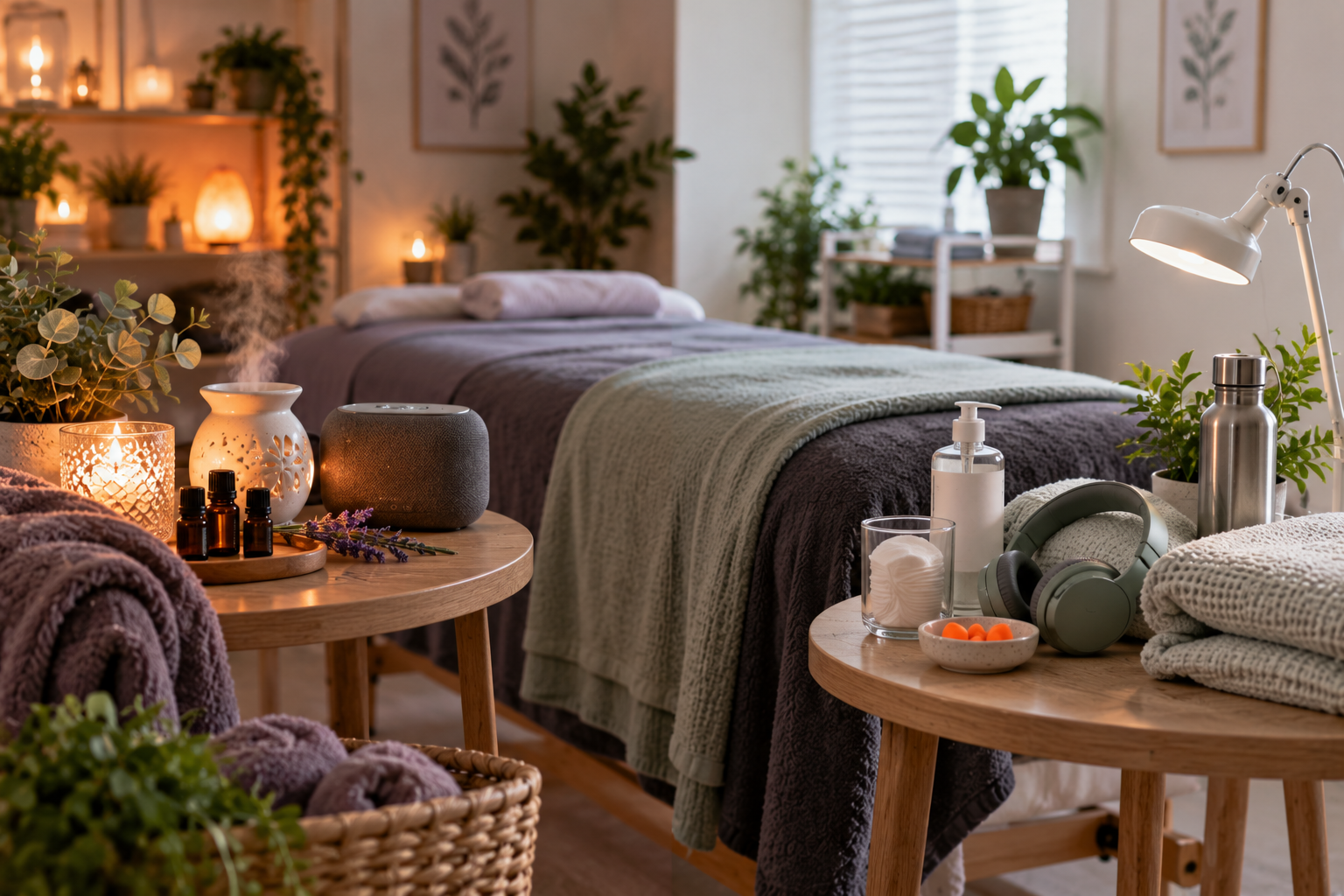
Dim the lights.
Put on some gentle music.
Light the scented candle.
Warm the couch.
Add a fluffy blanket.
Perfect.
We’ve created a relaxing treatment environment.
Haven’t we?
For many clients, absolutely.
For someone with sensory sensitivities, however, we’ve potentially created an hour-long assault on their nervous system.
One person’s relaxing treatment room can be another person’s:
“Please get me out of here.”
We don’t all experience our surroundings in the same way
Our brains are constantly receiving information.
Sound.
Light.
Touch.
Temperature.
Smell.
Movement.
Most of the time we process all of this without consciously thinking about it.
But people can experience sensory input very differently.
This is often discussed in relation to autism and ADHD, although sensory preferences and sensitivities certainly aren’t exclusive to neurodivergent people.
Someone may be particularly sensitive to sound.
Another person might find certain types of touch uncomfortable.
Someone else may struggle with strong smells, bright lights or heat.
And sometimes several of these things occur together.
Start with smell
Therapists love a nice-smelling treatment room.
Diffusers.
Essential oils.
Candles.
Room sprays.
Beautifully fragranced products.
Walk into some therapy rooms and your nose knows you’ve arrived approximately three minutes before the rest of you does.
For some clients, fragrance is lovely.
For others, it can be overwhelming.
And sensory preference isn’t the only consideration. Clients may also have allergies, respiratory conditions, migraine triggers or simply dislike the scent you’ve chosen.
A treatment room doesn’t have to smell of anything to feel relaxing.
Sometimes neutral is exactly what the client needs.
Then there’s music
Spa music has become almost synonymous with complementary therapy.
Gentle piano.
Nature sounds.
Whales apparently having a lovely time somewhere in the distance.
But not everybody finds background music relaxing.
Some people struggle to filter sound.
They may be trying to listen to you while also hearing the music, the clock ticking, footsteps outside the room and a car reversing somewhere down the road.
Their brain isn’t neatly placing those sounds into the background.
It’s processing everything.
For that person, silence may be far more relaxing.
So ask.
“Would you like music on or would you prefer quiet?”
It’s such a small choice.
Touch can be complicated
This one is particularly relevant when your job involves touching people.
A client may enjoy firm, predictable pressure but dislike very light touch.
They may be comfortable with massage on their back but find having their feet touched unbearable.
Certain textures might bother them.
They may dislike oil remaining on their skin.
Unexpected touch may make them jump.
None of this necessarily means they won’t enjoy massage or another hands-on therapy.
It may simply mean the treatment needs to be adapted.
Clear communication can help enormously.
“I’m going to move onto your right arm now.”
A tiny sentence gives the client information about what’s about to happen.
For someone who dislikes unexpected touch, that can make a big difference.
Don’t assume everyone loves being warm
Heated couch.
Electric blanket.
Extra blanket.
Hot towels.
Lovely.
Unless you’re lying there thinking:
“I am approximately seven minutes away from spontaneous combustion.”
Temperature preference varies enormously.
Hormonal changes, medication, health conditions and individual sensory differences can all influence how comfortable somebody feels.
Give clients control where possible.
“Are you warm enough?”
“Would you like the blanket on or off?”
Simple.
Lighting matters too
Low lighting can make a treatment room feel peaceful.
But extremely dim rooms aren’t comfortable for everybody.
Some clients may feel vulnerable if they can’t clearly see the environment.
Others may be particularly sensitive to bright overhead lights.
Fluorescent lighting can be uncomfortable for some people.
Again, there isn’t one universally relaxing setting.
Where practical, having adjustable lighting gives you options.
Consider the consultation too
Sensory overload doesn’t necessarily begin when the treatment starts.
Imagine arriving somewhere unfamiliar.
There’s music playing.
Someone immediately starts asking questions.
You’re completing paperwork.
The therapist is explaining the treatment.
Another person is talking outside.
You’re trying to remember your medication.
And you’re wondering where you’re supposed to put your clothes.
That’s a lot of information.
Clear instructions can make the experience easier.
Tell clients what will happen.
Give them time to answer questions.
Don’t fill every silence because you think it’s awkward.
And where appropriate, providing information before the appointment can make the environment feel much more predictable.
Choice doesn’t have to mean twenty questions
You also don’t need to hand every client a four-page sensory preference questionnaire.
A few simple questions can tell you a lot.
“Is the lighting comfortable?”
“Would you like music?”
“Are you happy with fragranced products?”
“How is the pressure?”
“Would you like me to explain what I’m doing as we go?”
You can incorporate these naturally into your consultation and treatment.
The aim isn’t to make the client feel different.
It’s to give them some control.
Watch for the client who keeps saying they’re fine
This is an important one.
Some clients will tell you immediately if they’re uncomfortable.
Others won’t.
They may not want to be difficult.
They may be unsure whether they’re “allowed” to ask you to change something.
They might be used to hiding discomfort.
Or they may become overwhelmed and find it harder to communicate what they need in the moment.
So don’t rely entirely on:
“Let me know if you need anything.”
Check in occasionally.
“Is that pressure still comfortable?”
“Are you warm enough?”
“Would you like me to turn the music down?”
Specific questions can sometimes be easier to answer than an open invitation to speak up.
You don’t need to diagnose anybody
Perhaps the most important thing is that none of this requires the client to have a diagnosis.
Someone doesn’t need to disclose autism, ADHD or any other condition before they’re allowed to dislike your diffuser.
You don’t need to decide whether somebody has a sensory processing difference.
You simply need to listen when they tell you what makes them comfortable.
That’s person-centred care.
Maybe we need to rethink what “relaxing” looks like
The therapy industry has developed a fairly standard picture of relaxation.
Candles.
Music.
Fragrance.
Darkness.
Warmth.
Soft touch.
And there is absolutely nothing wrong with any of those things.
If the client likes them.
But the relaxing environment isn’t the one that looks most like a spa photograph.
It’s the one where the person on the couch feels comfortable, safe and able to settle.
Sometimes that means music, lavender and a heated blanket.
Sometimes it means bright enough to see, no fragrance, no music and knowing exactly where you’re going to touch next.
Neither is more relaxing than the other.
The client gets to decide what relaxing feels like to them.