
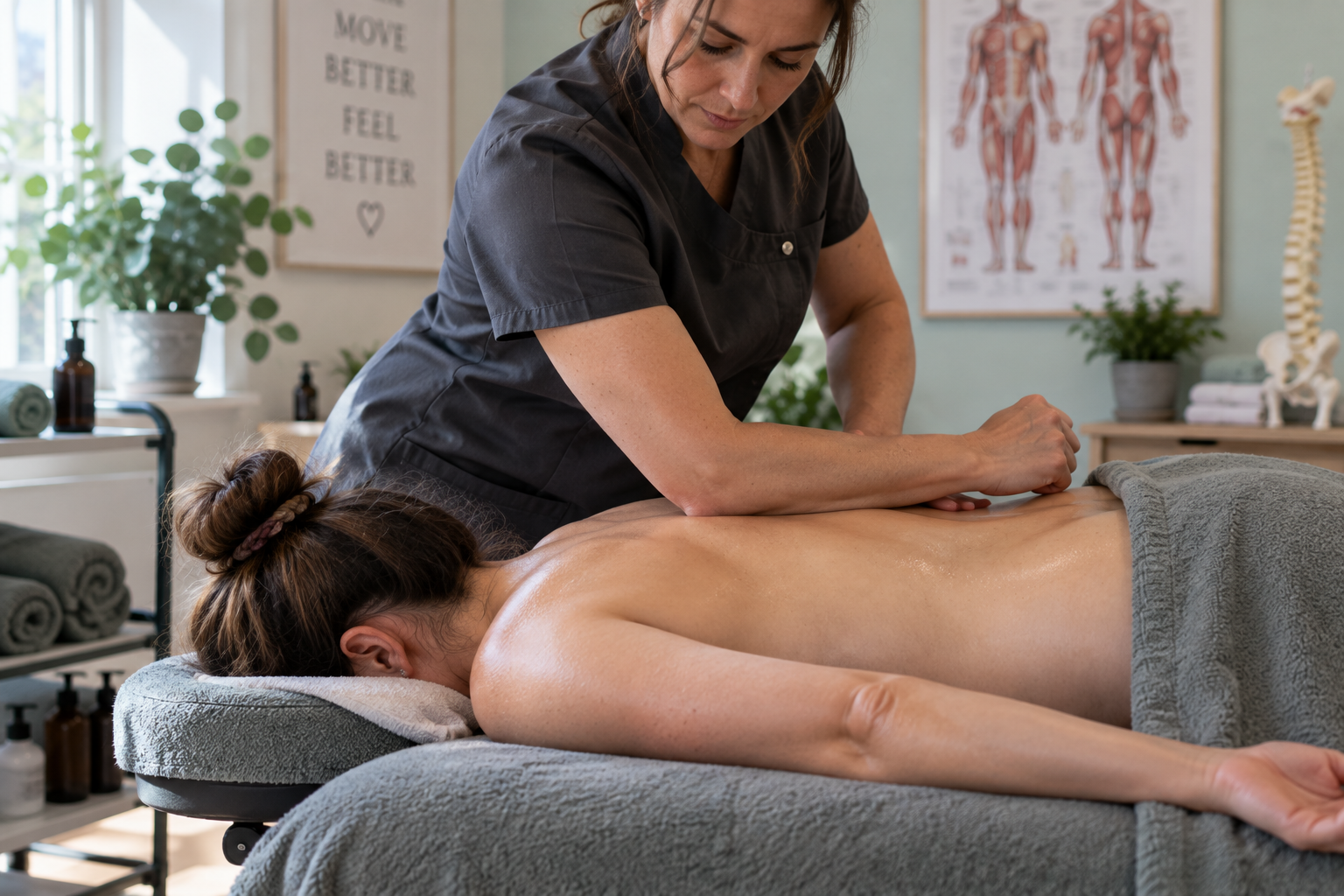
“Don’t worry, I can take it.”
“I like really deep pressure.”
“You can go harder than that.”
And the classic:
“No pain, no gain!”
Massage therapists hear these phrases all the time.
Some clients arrive almost expecting a battle.
They believe that if the massage doesn’t hurt, it isn’t doing anything.
And if they don’t leave feeling as though they’ve completed twelve rounds with a heavyweight boxer, apparently they haven’t received their money’s worth.
But does massage really have to hurt to be effective?
No.
And more pressure isn’t automatically better treatment.
Deep pressure and pain aren’t the same thing
A client can enjoy firm pressure without experiencing significant pain.
That distinction matters.
Massage may sometimes feel intense, particularly when working with areas the client describes as tender or sensitive.
A client might describe a sensation as:
“That’s strong, but it feels good.”
That’s very different from somebody gripping the couch, holding their breath and waiting for you to stop.
Pain isn’t proof that you’ve found the “right spot”.
And it certainly isn’t a requirement for an effective massage.
Watch the client’s body, not just their words
Clients don’t always tell you when something is too much.
They may believe massage is supposed to hurt.
They might not want to offend you.
Or they may think:
“She’s the professional. She must know what she’s doing.”
So pay attention.
Has their breathing changed?
Are they tensing?
Are their shoulders lifting?
Are their hands gripping the couch?
Are they pulling away from the pressure?
Then check in.
“How is that pressure?”
And give them permission to be honest.
“I can lighten it — it doesn’t need to hurt.”
That last sentence can be surprisingly reassuring.
More pressure doesn’t necessarily mean more skill
There can be a strange idea in massage that the deeper somebody works, the more advanced they must be.
But using maximum force isn’t particularly sophisticated.
Knowing when, where, how and whether to use pressure requires far more judgement.
A skilled therapist can vary pressure.
Change techniques.
Slow down.
Alter their position.
Respond to the tissue and, importantly, to the person attached to it.
Massage isn’t a competition to see how deeply we can press into somebody before they tap out.
The client doesn’t need to “put up with it”
This is where communication matters.
If a client believes discomfort is necessary, they may tolerate much more than they actually want.
Some will even apologise when asking you to reduce pressure.
“Sorry, could you go a little lighter?”
They don’t need to apologise.
It’s their treatment.
A useful consultation can establish this before you even begin.
You might explain:
“I’ll check the pressure with you, but please tell me at any point if you’d like it adjusted.”
Now changing the pressure is simply part of the treatment rather than a complaint.
What are we actually trying to achieve?
This is the question therapists should keep coming back to.
Why is the client here?
If somebody wants to relax, spending an hour bracing themselves against uncomfortable pressure probably isn’t helping.
If they’re experiencing muscular discomfort, more intensity isn’t automatically going to produce a better outcome.
If they’re anxious about being touched, forcing them to tolerate strong pressure certainly isn’t person-centred care.
Treatment should have a purpose.
The technique and pressure should support that purpose.
“But I need you to get the knots out”
Ah yes.
The knots.
Clients often describe areas of muscular tension as knots, and it’s a perfectly understandable everyday description.
But muscles aren’t shoelaces.
We aren’t physically untying something inside the body.
A therapist may feel areas that seem firmer, more sensitive or different from the surrounding tissue.
That doesn’t mean we need to attack them until they surrender.
Sometimes gentle or moderate work feels far more comfortable and still provides the experience the client is looking for.
We don’t need to win a fight with somebody’s trapezius.
Soreness afterwards isn’t a badge of honour
Some clients experience temporary tenderness after stronger massage.
That can happen.
But extreme soreness shouldn’t be treated as evidence that the massage was particularly effective.
A client shouldn’t need to spend the next two days recovering from their treatment to prove you worked hard enough.
If someone repeatedly leaves your treatment room feeling battered, it’s worth reconsidering the approach rather than congratulating yourself on an excellent deep tissue session.
Different people want different pressure
This is another reason fixed routines only take us so far.
One client loves firm pressure.
Another finds it unpleasant.
Someone may want stronger work on their back but much lighter pressure on their legs.
Pressure that felt wonderful last month may feel completely different today.
There isn’t one perfect pressure setting.
The client isn’t a washing machine.
We can’t select Deep Tissue – Level 4 and leave it there for sixty minutes.
Keep communicating.
Therapists need protecting too
There’s another person we sometimes forget in the pursuit of ever-deeper massage.
The therapist.
If you’re using enormous amounts of muscular effort to force pressure through your thumbs for several hours every day, your own body may eventually object.
Good body mechanics, appropriate use of body weight and a variety of techniques matter.
You shouldn’t have to injure yourself to convince the client they’ve had a proper massage.
A good treatment isn’t measured by how much it hurts
Clients sometimes arrive with very fixed ideas about what massage should feel like.
That’s okay.
We can listen to their preferences.
But we’re also professionals.
Part of our role is explaining what we do and why.
We don’t have to reinforce the idea that pain equals effectiveness.
A treatment can be firm.
It can be focused.
It can feel intense.
It can also be gentle, slow and deeply relaxing.
What matters is that it’s appropriate for the person receiving it.
So the next time somebody tells you:
“Don’t worry about me. You can’t hurt me.”
You don’t need to accept the challenge.
Because good massage isn’t about seeing how much pressure somebody can tolerate.
It’s about knowing how much they actually need.