Therapists spend a lot of time thinking about other people’s bodies.
Is the client comfortable?
Is the pressure right?
Can they turn over easily?
Do they need another pillow?
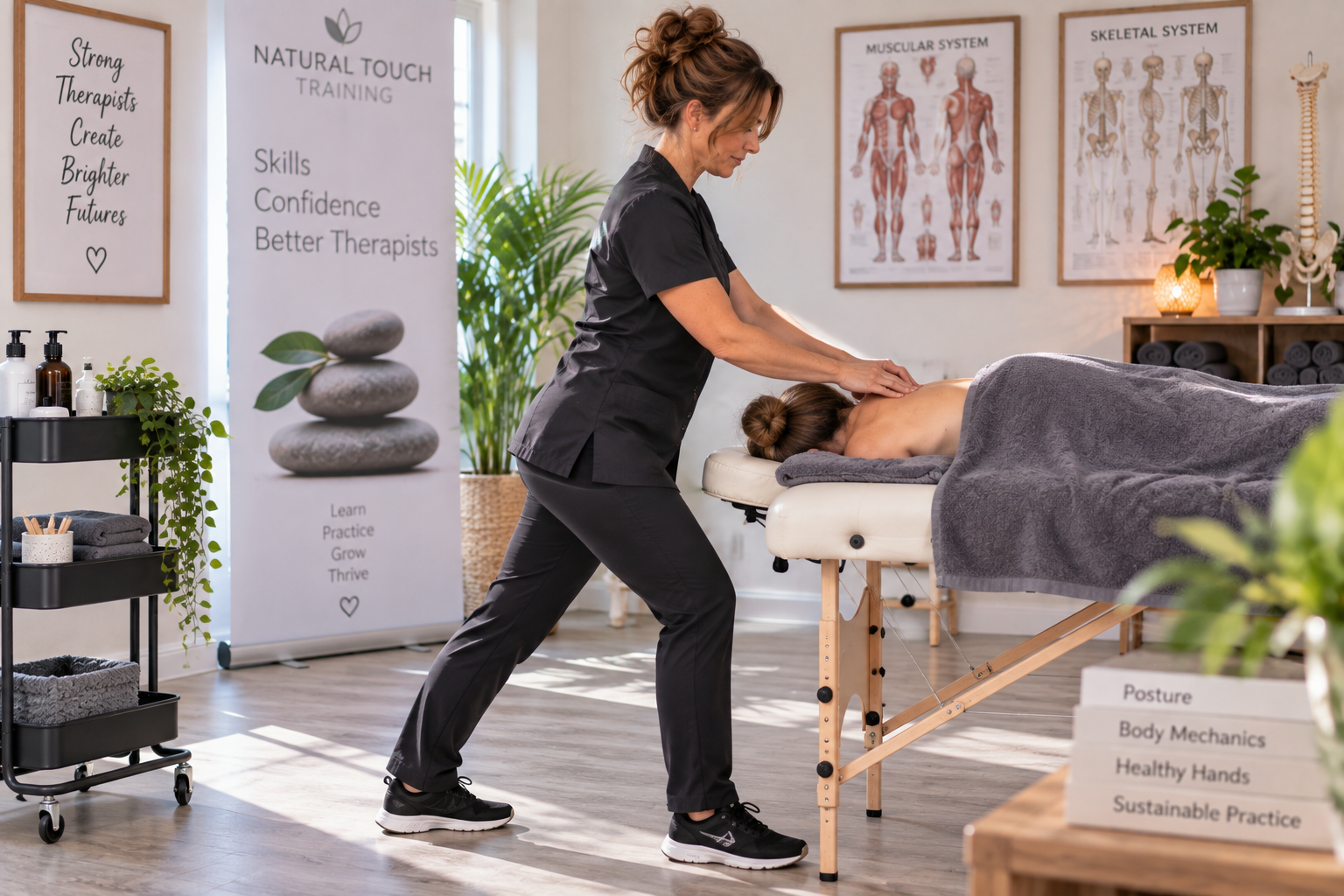
Meanwhile, the therapist is leaning across the couch at a 45-degree angle, shoulders somewhere near their ears, wrists bent and feet rooted to the floor.
Sound familiar?
When you work in hands-on therapy, your body isn’t just the thing that gets you through the working day.
It’s one of the tools of your trade.
And unlike your massage couch, you can’t order another one when it wears out.
Good body mechanics aren’t just something you learn for the assessment
Most practical therapy courses teach posture and body mechanics.
Then students qualify, get busy and gradually start developing some very creative working positions.
The problem is that poor posture often doesn’t hurt immediately.
You can lean over a couch awkwardly for one treatment and feel absolutely fine.
Do it repeatedly, several clients a day, several days a week, and your body may eventually have something to say about it.
Good working posture isn’t about looking elegant.
It’s about reducing unnecessary strain.
Check your couch height
One of the simplest things you can change is the height of your treatment couch.
Yet therapists frequently leave it at exactly the same height for everything.
The right height can vary depending on the treatment, the area you’re working on, your own height and how much pressure you need to apply.
Too high and you may find yourself lifting your shoulders and working excessively through your arms.
Too low and you may spend the entire treatment bending through your back.
Adjust it.
That’s why the legs have all those holes in them.
Pressure shouldn’t come entirely from your hands
This becomes particularly important with massage.
Clients sometimes ask for “really deep pressure”.
The temptation is to push harder with your thumbs, hands and shoulders.
For an hour.
Your thumbs may file a formal complaint.
Effective pressure should make use of good positioning, body weight and appropriate techniques rather than relying purely on muscular effort through small joints.
Move your feet.
Shift your weight.
Position yourself appropriately.
Use the techniques available within your training.
Working harder isn’t always the same as working better.
Your thumbs are not indestructible
Massage therapists in particular can become very thumb-dependent.
Thumbs are wonderfully useful.
They are not designed to spend six hours a day battling everybody’s upper trapezius.
Use different tools where your training allows.
Palms.
Forearms.
Knuckles.
Fingers.
Appropriate supported techniques.
Variety isn’t only useful for the client.
It distributes the workload across your own body.
And if something is hurting while you work, don’t simply accept that as part of being a therapist.
Pain is information for us too.
Think about your diary, not just individual treatments
A treatment might be perfectly manageable.
Six of them back-to-back may be another story.
When you’re building your diary, consider the physical demand of what you’re booking.
Three deep tissue massages in succession may feel very different from a day containing a mixture of treatment types.
You also need time to change the room, complete records, eat, drink and occasionally use the toilet.
Revolutionary, we know.
A completely full diary isn’t automatically a well-designed diary.
Build gaps on purpose
Therapists often see gaps between clients as wasted earning time.
But a short gap can allow you to reset the room, stretch, complete your notes and mentally finish one appointment before the next person arrives.
It can also prevent the dreaded situation where one client arrives early while the previous client is still enthusiastically telling you a story ten minutes after their treatment ended.
Your working day needs breathing space.
That doesn’t mean leaving an hour between every appointment.
It means avoiding a schedule that only works if absolutely nothing runs late.
Because something will.
Look after your general strength and fitness
You don’t need to become an athlete to work as a therapist.
But hands-on therapy can be physically demanding.
General strength, mobility and fitness can make that work easier.
Your legs help you move and transfer weight.
Your trunk helps provide stability.
Your shoulders and upper body need to tolerate repeated movement.
The stronger and more capable your body is generally, the better equipped it may be for the demands you place on it at work.
And no, providing six massages doesn’t count as your strength-training programme.
Nice try.
Your working environment matters
Sometimes the problem isn’t your technique.
It’s your setup.
Are you constantly twisting because your products are behind you?
Is the room so small that you can’t move properly around the couch?
Is your stool the wrong height?
Are you bending to reach equipment dozens of times each day?
Small changes to where things are positioned can make a surprisingly big difference over hundreds of treatments.
Set the room up for the therapist as well as the client.
Rest is part of running the business
When you’re self-employed, there’s always the temptation to squeeze somebody else in.
Especially when the diary is busy.
One more client.
One extra evening.
Just this Saturday.
Occasionally, that’s fine.
But if “just one more” becomes your normal working pattern, eventually you may find that the business depends on you working at a level you can’t comfortably sustain.
Your earning capacity isn’t simply determined by how many appointment slots exist in a week.
It’s also determined by how many treatments you can provide consistently without exhausting yourself.
Longevity matters
When you’re newly qualified, it’s easy to think about filling next week’s diary.
But what if you want to still be doing this in ten years?
Twenty?
Building sustainable habits early is much easier than trying to undo years of poor ones later.
Adjust the couch.
Use your body effectively.
Vary your techniques.
Take breaks.
Build your general strength.
Pay attention when something starts hurting.
And create a diary that allows you to be a human being rather than a massage-producing machine.
Your clients’ bodies matter.
But so does yours.
Because your body isn’t separate from your therapy business. It’s what allows you to have one.